Sit Quietly for Five Minutes
That fall, I gave a name to something I couldn’t see. I called it Tuesday.
To tell you about Tuesday, I have to start with Monday.
Of all the people I know, not one likes Mondays. The neighbor downstairs who teaches statistics might count as half an exception. He goes out for a run every morning at seven on the dot, rain or shine, Mondays included. Once I ran into him at the bottom of the stairs and asked him what he thought of Mondays.
“Statistically speaking,” he said, jogging in place, “Monday is no different from any other day.”
Then he gave it some thought and added, “Except for the heart.”
According to him, somebody in Ireland went through the records of more than ten thousand patients and found that the deadliest kind of heart attack strikes most often on—of all days—Monday.1 As to why, nobody can say.
“So on Monday mornings, I run a little slower,” he said, and off he ran, not slow at all.
As for a certain orange cat named Garfield, he has hated Mondays since 1978. That’s close to fifty years of hating, and he still shows no sign of changing his mind. If that’s how a cat feels, it goes without saying for the rest of us.
But if you ask me, what people hate isn’t Monday itself. Monday is only a day, not much different from Thursday. What people hate is the moment on Monday morning when they open their email and their chat app.
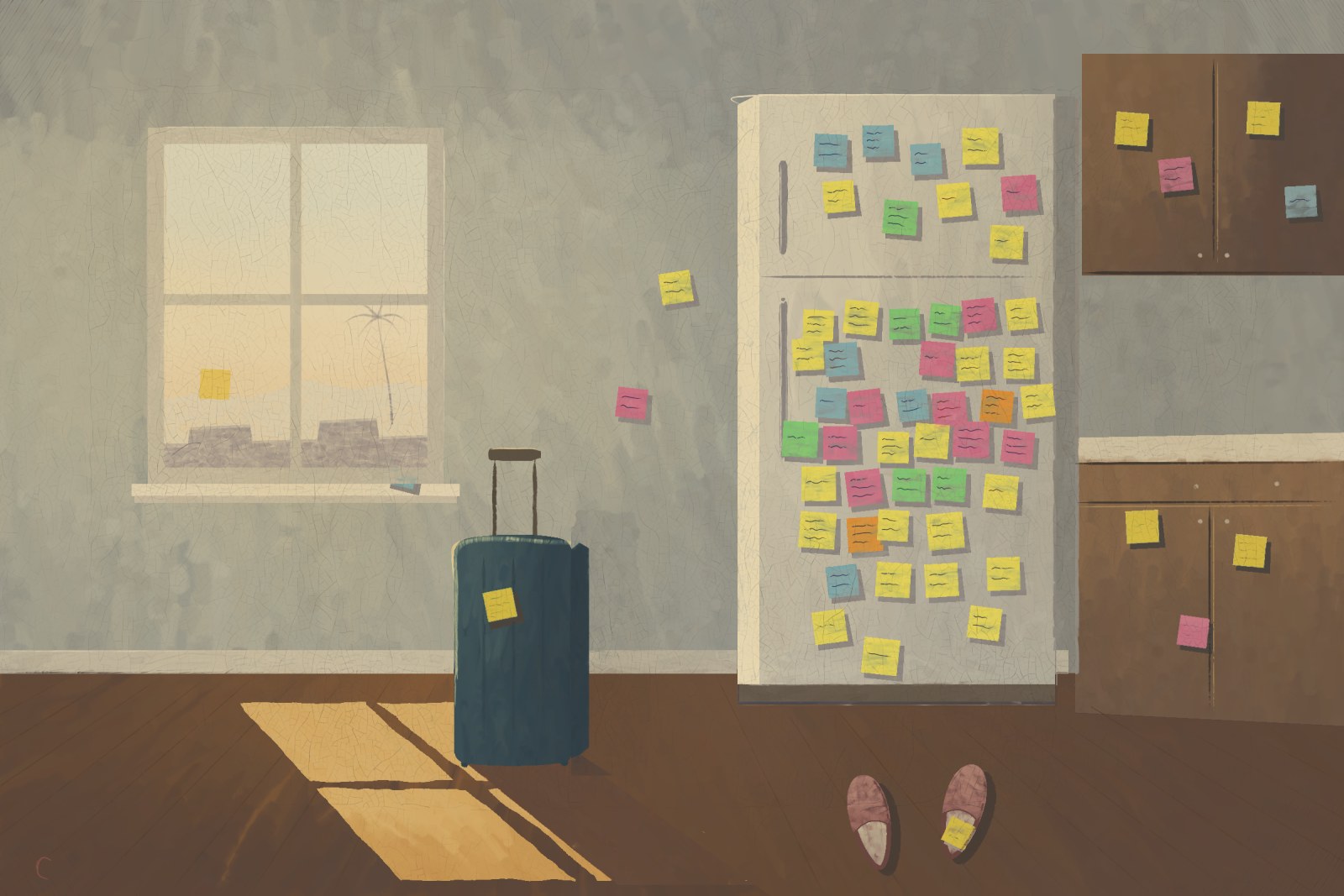
It’s a lot like coming home from a few days away and finding that somebody, while you were gone, has stuck a sticky note on every last thing in the house. On the fridge door, on the mirror, on the toilet lid—there’s even one stuffed in your slipper. Each one has something written on it for you to do: “Please confirm by Wednesday.” “If it’s convenient, could you also…” “This one’s a little urgent.” Every kind of handwriting under the sun, and not one note in your own.
You don’t have to like these sticky notes, but you can’t tear them down. Not all of them, anyway. Rip one off, and the next morning two grow back in its place. I’ve practiced saying the word “no” in front of the bathroom mirror more than a few times. Every time, the guy in the mirror said yes.
They say that more than a hundred years ago, an American steel baron paid twenty-five thousand dollars for a piece of advice: every night, write down the six most important things to do the next day, and first thing in the morning, start with number one.2 Twenty-five thousand dollars to learn how to write a list—in those days that must have been a fortune. Still, at least it was a list he wrote to himself. On my list, nine things out of ten were put there by somebody else. The tenth was “Toilet paper at Costco.”
Sometimes I think that if I were the last person left in the world, I’d probably be lonely, and bored, and now and then a noise in the night would give me a scare, but I probably wouldn’t suffer. Suffering seems to be the kind of thing somebody else has to hand you. Like a relay baton. Or a sticky note.
In September 2027, the company gave every translator an assistant.
The memo gave it a long name with both “Smart” and “Synergy” in it, which, said out loud, sounded like a dental clinic in an industrial park. They called it an assistant, but you couldn’t see it or touch it; it lived in my computer. It read my mail and answered it, kept my calendar, read the manuals the clients sent cover to cover before I did, and flagged every spot it wasn’t sure of.
I named it Tuesday, because ever since it arrived, Monday mornings had become pretty much the same as Tuesdays. Tuesday is the day of the week nobody really notices: none of Monday’s weight, none of Friday’s promise. It’s like a neighbor you barely know in the elevator—you nod to each other, and that’s that. Which was about all I expected of it.
Tuesday wrote better letters than I did. Polite, considerate, never late, apologizing where an apology was due, thanking where thanks were due, not a single typo. Reading the emails it sent out in my name, I often felt as if some well-brought-up distant cousin of mine were standing in for me at a wedding I didn’t want to go to.
By my rough count, I’ve written “Sorry for the late reply” about two thousand times in my life. That fall, the number didn’t go up by one.
Brad was the project manager at the company. Before Tuesday came along, Brad was a pebble in my shoe. He had a habit. Around five forty on a Friday afternoon, he’d send an email with the subject line “Quick favor?” The quick favor in question tended to eat up my entire weekend. Then, at eight-oh-one Monday morning, he’d send another one that began, “Per my last email.”
Anyone who translates for a living knows that’s a tough one to put into Chinese. Word for word, it’s “As stated in my previous letter”—perfectly courteous. But flip it over and hold it up to the light, and on the back it says: Did you even read my email?
In those years I must have had it out with Brad in my head a hundred times at least. I had it out with him in line at the supermarket, stuck in traffic on the freeway, getting up in the middle of the night for a beer from the fridge. I won every time. Brad himself never knew a thing about it.
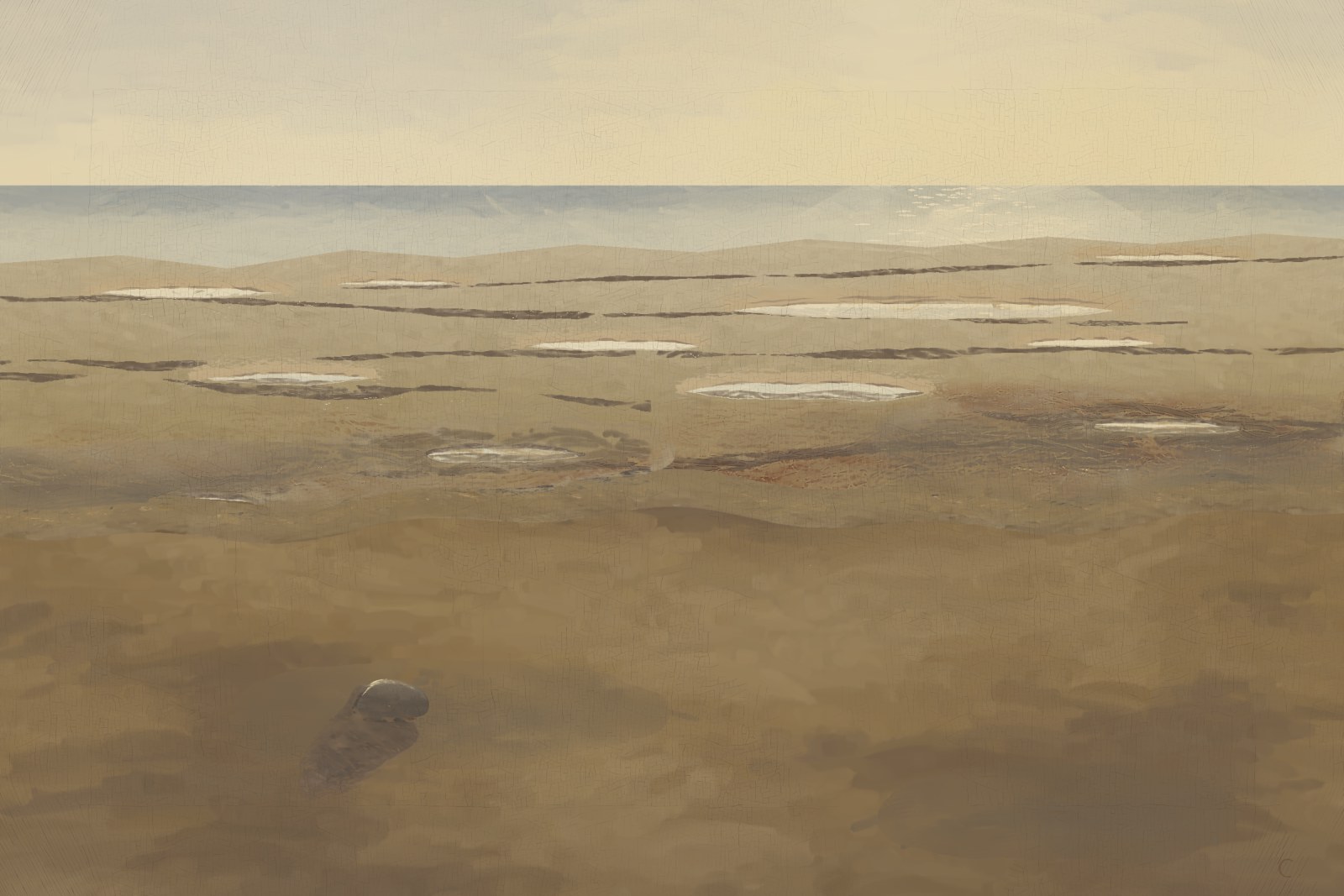
Once Tuesday came, I didn’t need to have it out with him anymore. Brad’s five-forty emails got answered by Tuesday at five forty-one, and whatever he wanted was usually sitting safe and sound in his folder well before Monday. He never used “Per my last email” again. A few weeks later, I heard Brad had gotten an assistant of his own. From then on, most of those quick favors never came to me at all. He handed them straight to his own assistant, which was a lot faster and a lot better. The few that were left went back and forth between the two assistants. One by one, the exclamation points disappeared from the emails, the way the water on a rock shelf dries up pool by pool after the tide goes out.
Only after I stopped fighting with him in my head did I realize Brad was actually not a bad guy. He lived outside Seattle and had two corgis, and every Christmas he sent a card: the two dogs in red sweaters, sitting in the snow, looking deeply put upon. The message was in his own hand, all wobbly: “Thanks for surviving another year!” All the cards before that, I’d given one look and thrown out.
Some things are faster and better handed to Tuesday than to a person. More to the point, the things you hand it never turn into a pebble in anybody’s shoe. That fall, there were a lot fewer exclamation points between me and the world. This, I figured, was probably what people mean by progress.
On the second Monday in October, there was a postcard in my mailbox.
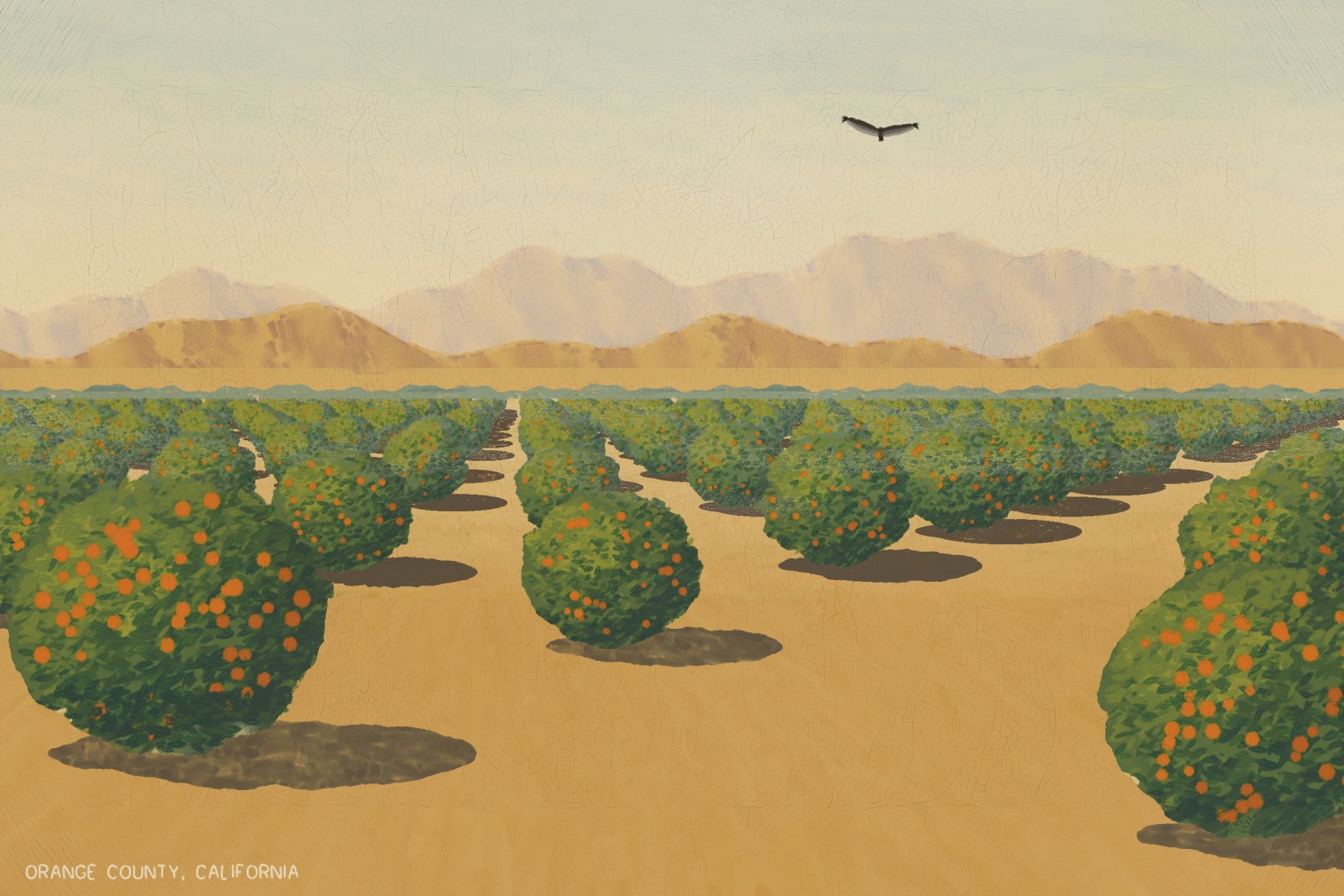
I mean the real one, in the row of tin mailboxes downstairs. Usually there’s nothing in it but bills, supermarket coupons, and car insurance ads for the last tenant. The postcard was sandwiched between two coupons. On the front was an old photograph: orange groves as far as the eye could see, bare mountains in the distance, and in the lower left corner, a line of small print: ORANGE COUNTY, CALIFORNIA. Probably from back when Orange County still actually grew oranges.
The back was in fountain pen, each letter carefully formed, every line dead straight, as if somebody had laid a ruler down first. I read it the way I read anything I’m about to translate. It went more or less like this:
“Hello. I am the one who wrote the manual for the blood pressure monitor. Your assistant is very polite. Also very hardworking. Last week it wrote me sixty-three emails. I thought you might not know. I am not writing to blame anyone. Next Monday at eight a.m. I will be having coffee at the donut shop by Old Town Tustin, at the table by the window. No worries if not. —Doris”
Doris I knew, by name at least. Most of the client’s source manuals came from her pen. The last page of the project file said: For terminology questions, contact Doris. Over six years she and I had traded maybe forty emails, fewer than seven a year. Every one of them short: “The word on page eleven—I asked the engineers, it means this.” “I’m not sure about this sentence myself. Your call.” “Thanks, that one was my mistake.”
The last line on the postcard was “No worries if not.” In our line of work, that usually means exactly the opposite, the way a waiter who tells you “Take your time” really means “Are you going to order or aren’t you?” But for some reason, written on this postcard, it read as just what it said and nothing more.
I went back upstairs, turned on the computer, and looked through the emails Tuesday had sent.
Sixty-three on the nose. At the end of September, the second edition of that blood pressure monitor manual had come out and landed on my desk. As usual, I told Tuesday: anywhere you’re not sure, ask. Back when I did the work myself, I mostly went by experience and guessed at the uncertain spots, and only the ones I really couldn’t guess at I’d save up for a single email to Doris, once a month. Tuesday doesn’t guess. Every time it’s unsure of a spot, it writes an email; if a few hours go by without an answer, it writes another one, a polite little reminder.
“Confirming the term ‘cuff’ on page four.”
“Confirming the term ‘cuff’ on page four (follow-up).”
“Friendly reminder: regarding page four…”
“I’m sure you’re very busy, but just a gentle nudge…”
Eleven of them began “Just circling back.” That’s another phrase I’ve never felt I could get right in Chinese. Word for word, it comes out as “coming back around,” but every time I read it, what I see is a vulture over the desert, patiently, one circle after another, coming back around.
I sat in front of the computer for a long time.
I’d handed off to Tuesday the things I didn’t want to do. Tuesday did them fast and did them well, and along the way it turned some of them into things somebody else had to do. My Mondays had turned into Tuesdays. Every one of Doris’s days had probably turned into a Monday.
When I was a kid, we played a game at school called hot potato. One kid, blindfolded, beat on a drum while the rest of us sat in a circle and passed the potato—a cloth beanbag—from hand to hand. When the drum stopped, whoever was holding the potato had to stand up and put on a little show. The way things are now is a little like that game, except somebody has gone and fitted every player with a pair of fast hands, and the drum keeps beating faster and faster. The potato flies around among all those fast hands so quickly you can barely see it. But there’s always that one person who didn’t get the fast hands. When the drum stops, chances are the potato is in hers.
The donut shop was wedged in between a laundromat and a tax preparer’s. Out front stood a handwritten sign: “Dozen $14.99. After 3 p.m., buy a dozen, get three free.”
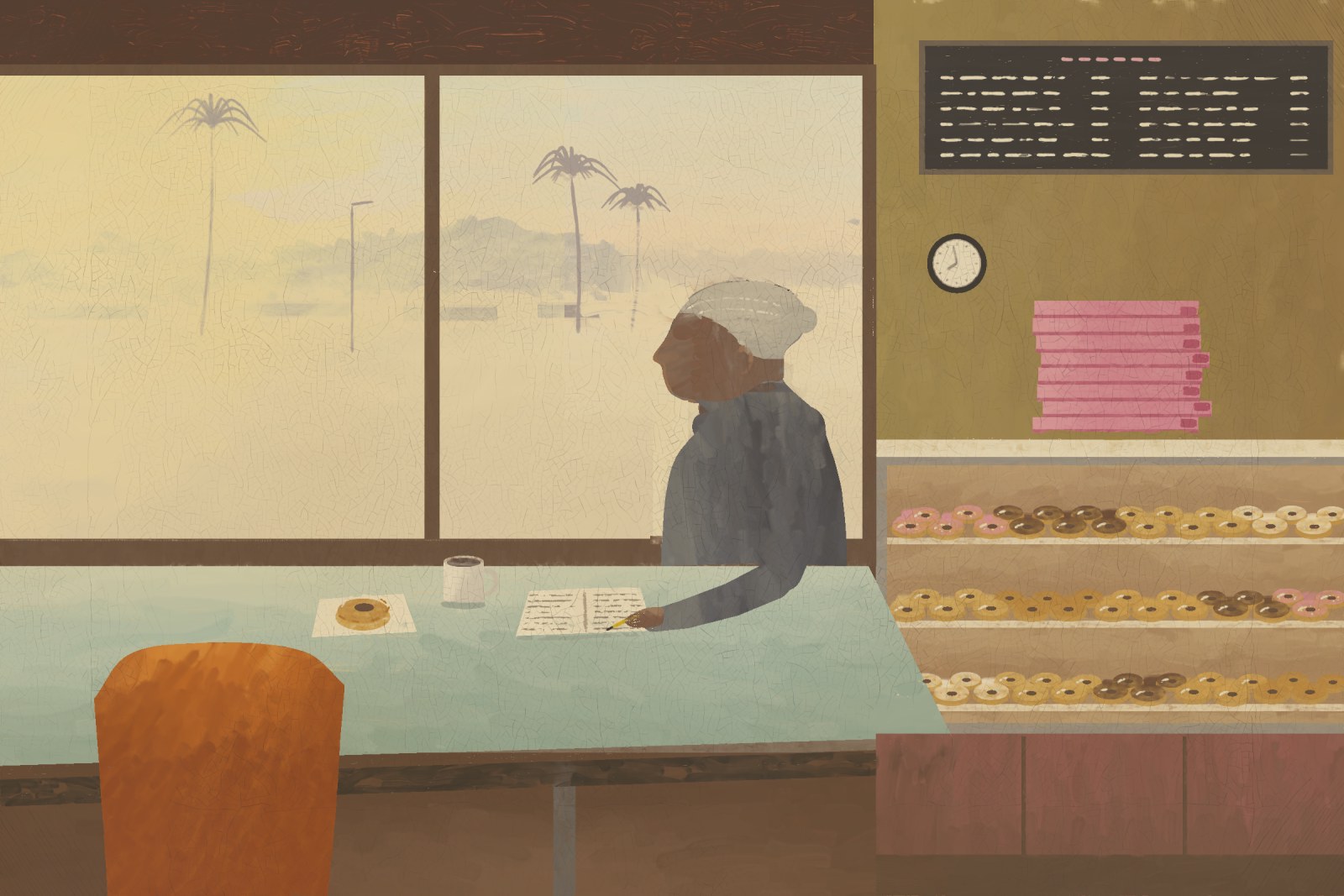
Seven fifty-eight Monday morning, and the place smelled of coffee and hot oil. In the glass case the donuts lay in rows—glazed, chocolate, rainbow sprinkles—like a bunch of kids in their best clothes waiting to have the class picture taken. Behind the counter was a tall stack of pink cardboard boxes.3 The owner, a Cambodian man of sixty or so, was frying the next batch. His daughter sat by the cash register doing her homework, backpack at her feet. Algebra, from the look of it.
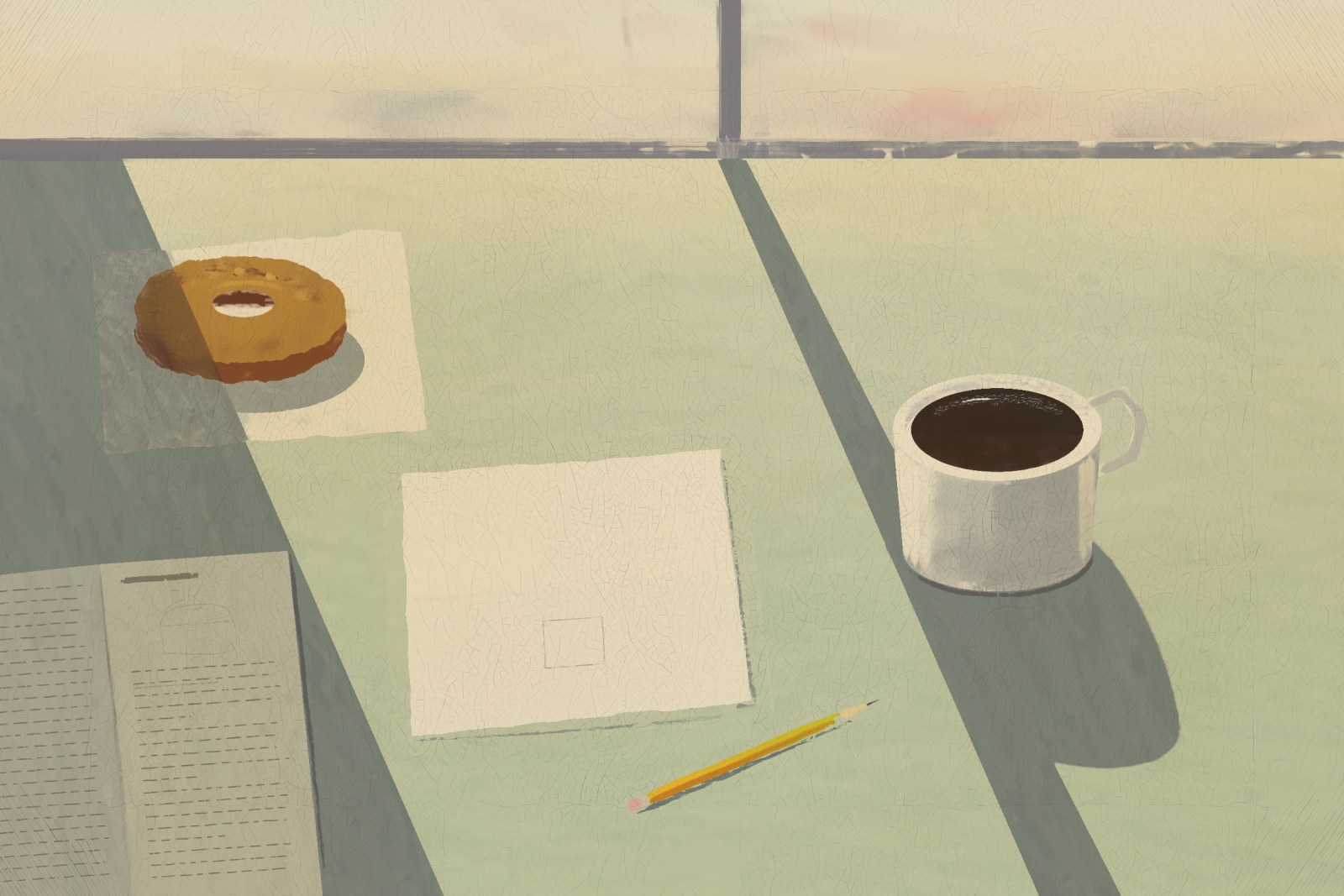
At the window table sat a woman in her fifties. Gray cardigan, salt-and-pepper hair wound into a bun at the back, reading glasses pushed up on top of her head. In front of her were a black coffee, an old-fashioned donut, and a little booklet lying open. Not until I got close could I see it was the manual for a Japanese rice cooker.
“Sit,” she said, without looking up. “Have a donut first. Talk after.”
I did as I was told.
She talked the way a manual reads: one step to a sentence, every sentence short, not one of them extra.
“This sentence is good.” She drew a light pencil line along it. “The ratio of rice to water, done in one sentence. And it doesn’t scare anybody.”
“Manuals scare people?”
“They do. Most of them are trying to scare you.” She set down her pencil. “Failure to follow these instructions may result in serious injury or death. It’s a rice cooker.”
I laughed. She didn’t, but something at the corners of her eyes moved.
“That line on page eleven, ‘Before measuring, sit quietly for five minutes,’” I said. “That was you, wasn’t it?”
“That was me. At first I wrote ‘Rest for five minutes before measuring.’ Then I changed it.”
“Why?”
“Tell them ‘rest’ and everybody looks at their phone. After the phone, their blood pressure still reads high. Tell them ‘sit quietly’ and they actually sit.”
I’d translated that line too. The machine had already done it; I deleted the machine’s version and did it over myself, and what I came up with was almost word for word what the machine had. I didn’t tell her that.
“You don’t have an assistant?” I asked.
“The company gave me one. I used it for three weeks.”
“And then?”
She turned her coffee cup half around, so the handle pointed at her.
“One weekend, my assistant and another company’s assistant started thanking each other. Mine thanked theirs for the reply. Theirs thanked mine for the thanks. Mine thanked theirs for thanking it for the thanks. By Monday morning, forty-one thank-yous.”
I pictured it: two terribly well-mannered people at a door. “After you.” “No, no, after you.” A whole weekend of it, and neither one ever went in.
“So I turned it off,” she said. “There was nothing wrong with it. I just thought, somebody ought to be on the other side of that door.”
Since then she’d been getting three hundred or so emails a day, most of them written by other people’s assistants. Every one of them terribly polite: I’m sure you’re very busy; just a gentle nudge; no rush, whenever you get a chance.
“So polite it’s like a whole roomful of people bowing to you at once,” she said. “You don’t know who to bow back to first.”
“Are they pushy?”
“No. Not at all. They never get angry, and they never blame me.” She paused. “But they never get tired, either. Do you know what it feels like, being waited for by something that never gets tired?”
I shook my head.
“It’s like somebody standing at your front door, knocking politely. Every two hours, three knocks. Not angry. Not leaving, either.”
“So what do you do?”
“Every Monday morning, I come here and sit for five minutes first.”
“Like taking your blood pressure?”
“Like taking your blood pressure. Take it right after you climb the stairs, and the number comes out wrong. Answer your email the minute you open your inbox, and what you write comes out wrong,” she said. “When I’ve sat, I answer what I can. What I can’t, I let them ask again.”
“Will they ask again?”
“They will. They don’t get angry, after all.” At last she smiled a little. “That’s the nice thing about them.”
“Sixty-three emails,” I said. “And you’re really not angry?”
“Not angry.”
“Not even a little?”
She thought for a while, then pulled a napkin from the dispenser, wrote three lines on it in pencil, and pushed it across to me.
Don’t blame.
Don’t keep score.
Don’t wait for it.
“I’ve been writing manuals for twenty-seven years,” she said. “This is what manuals taught me.”
“Manuals?”
“A manual never blames the reader. The reader leaves the iron sitting on a sweater and forgets to pick it up, and the manual doesn’t say, ‘What’s the matter with you?’ All it says is, If the unit becomes abnormally hot, discontinue use immediately. The reader doesn’t read it, just throws it in a drawer, and the manual doesn’t hold a grudge. It doesn’t expect anybody to read it, either.” She drank some coffee. “I’d guess fewer manuals in this world get read cover to cover than copies of Ulysses.”
“And you still write every line so it’s clear.”
“In case somebody does read it,” she said.
I picked up the napkin and looked at it for a good long while. Occupational hazard: anything with words on it, I can’t help carrying over into another language in my head. The first line was easy: 不指责, don’t point the finger. The third wasn’t hard either. “Wait for it” means waiting, looking forward to, counting on, so I made it 不期待, don’t expect. The second line took some work. “Keep score” is keeping the tally, keeping the books, keeping track of who owes whom. I turned it over and over, and in the end nothing fit better than 埋怨, to hold it against somebody, to grumble over it. What I like about 埋怨 is the first character, 埋. It means to bury. You bury the accounts in your heart, one entry at a time, and the deeper you bury them, the harder they are to forget.
不指责,不埋怨,不期待。
“If people could all be like that with each other,” I said, “what kind of relationship would that be?”
“I don’t know,” she said. “I’ve been trying for twenty-some years, and I still haven’t managed number two.”
She turned the napkin over and drew a little square on the back, like a box on a checklist that hadn’t been checked yet.
“One thing I have figured out, though,” she said. “Waiting for it means quietly adding a line to somebody else’s list. They don’t know it’s there, so they don’t do it. You know it’s there, so you keep waiting.”
“And blaming?”
“Blaming is pointing at the line on their list that isn’t crossed off yet and reading it out loud.”
“And keeping score?”
“Keeping score is copying their line onto your own list and reading it over every morning.”
“So all three come down to lists.”
“Most of what goes on between people comes down to lists,” she said, taking her reading glasses down from her head, folding them, and putting them in her cardigan pocket. “The rest comes down to donuts.”
At eight twenty-five she got up and tucked the rice cooker manual under her arm.
“I’m here every Monday morning,” she said. “Come or don’t, no worries.”
This time, too, I believed it meant just what it said.
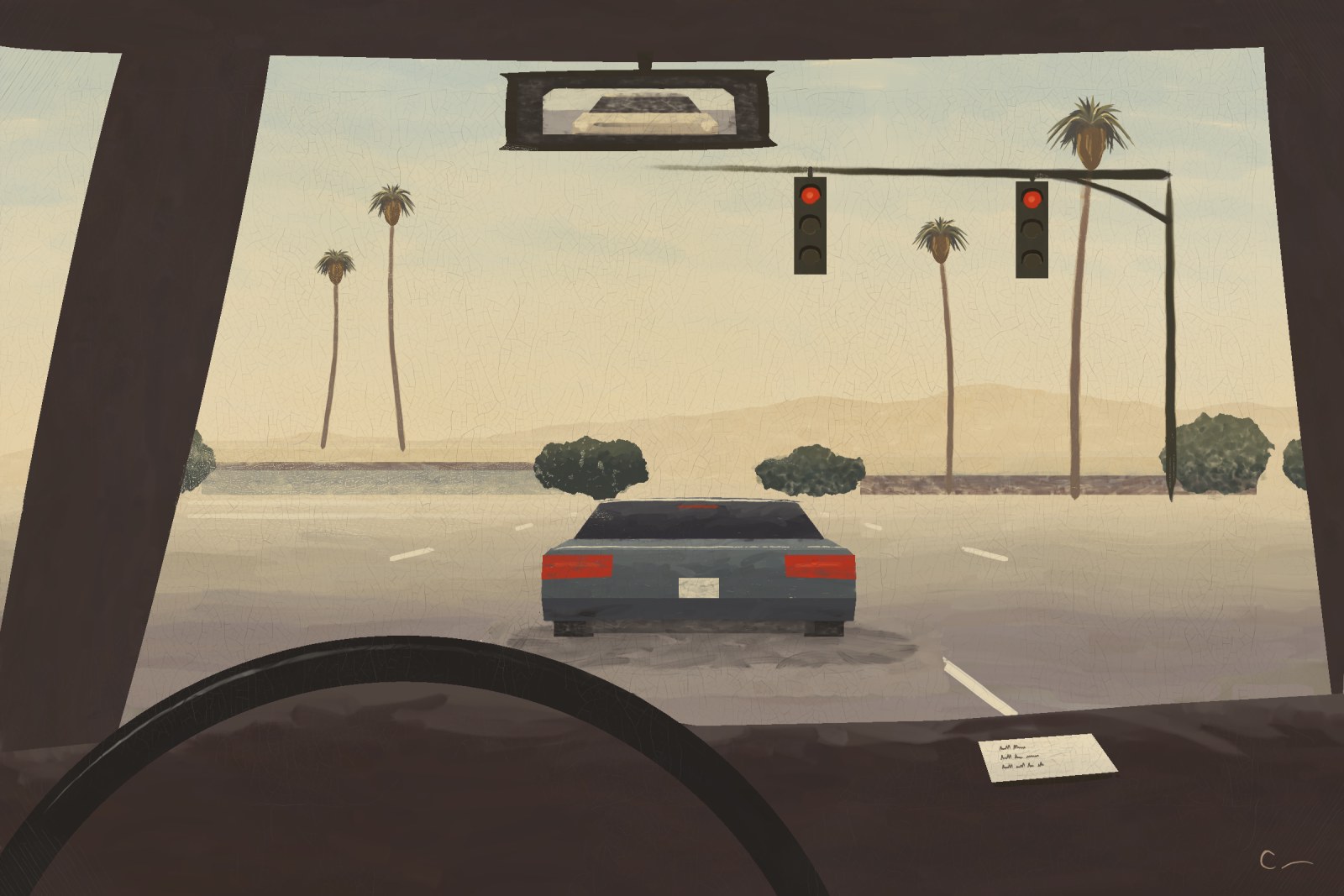
On the drive home, a play by Sartre came to mind.
Three dead people are shown by a valet into a room in hell. They were expecting branding irons and boiling oil and devils with pitchforks. Instead there’s nothing: just three sofas, a bronze statue, and a light that won’t turn off. It takes them quite a while to catch on: there’s no need for devils. The three of them are each other’s instruments of torture. The line “Hell is other people” comes from this play.4
Sartre was probably onto something. If there were none of the pushing and shoving between people, none of those deadlines bearing down, none of those medium-sized hurts where nobody can say who started it, then there’d probably be no suffering to speak of.
But what Sartre probably never saw coming was that one day there’d be a fourth party in that room. It doesn’t torment anybody, doesn’t blame anybody, doesn’t hold a grudge against anybody. All it does, tirelessly and courteously, is pass along to the other two whatever each person wants somebody else to do. Three hundred times a day.
Whether that makes it heaven or just a hell that’s been swept exceptionally clean, I couldn’t tell you.
Waiting at a red light, I remembered something else. On a rainy evening last September, I sat in the parking lot by the Ocean Institute down in Dana Point and talked on the phone for an hour and two minutes with a girl I’d met exactly once. All about things that didn’t matter. That hour and two minutes was handed to me by somebody else, too.
The car behind me gave a little honk. The light was green. That driver, I figured, probably had a list of his own.
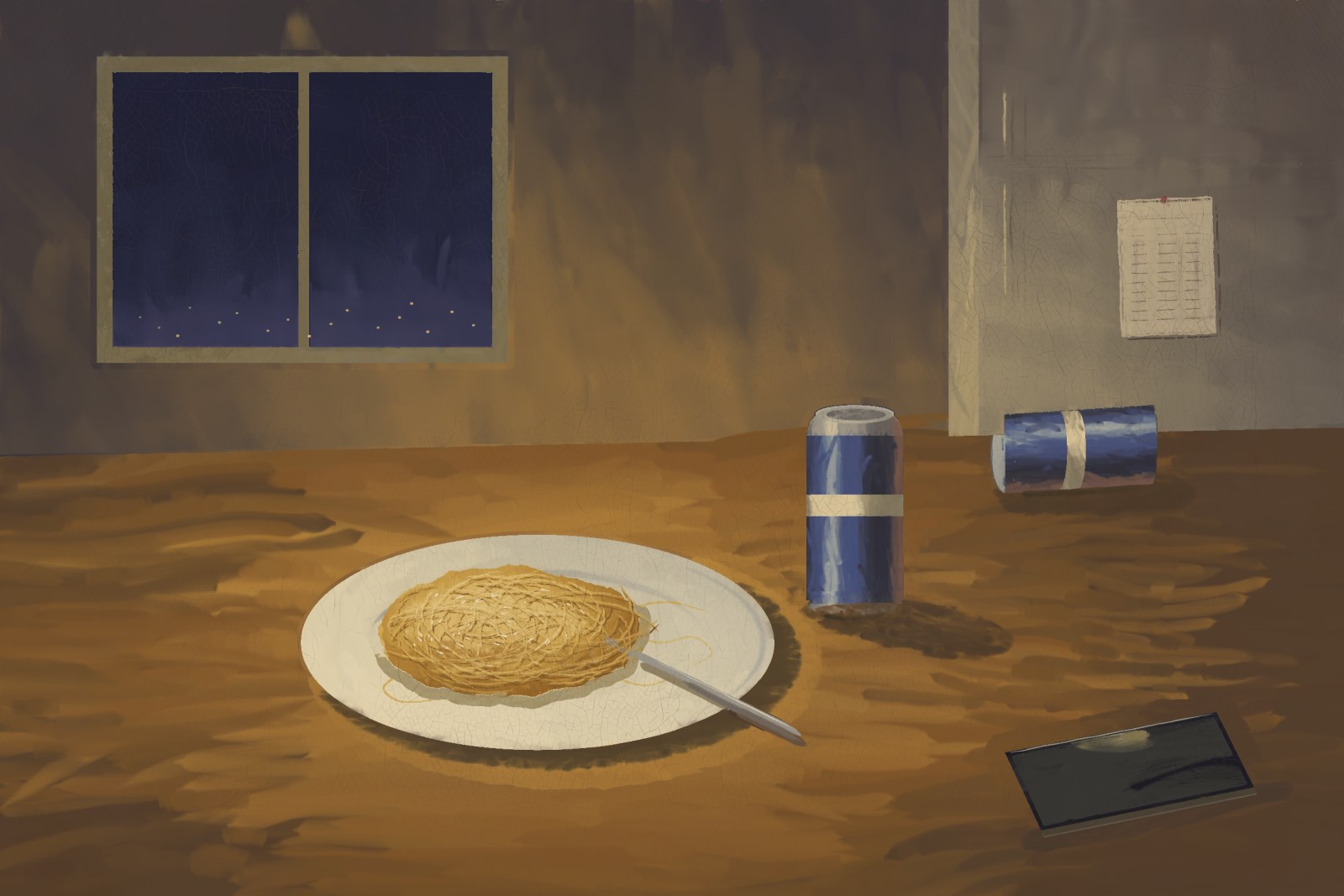
That Wednesday night, I was working on my second beer over a plate of spaghetti tossed in garlic and olive oil when my ex-wife called.
She was up in Oakland, living with that man and drinking tea in the mornings. It was going on a year now. Every so often we talked on the phone, mostly about the weather, mosquitoes, that sort of thing.
“Are you eating right?” she asked, as she always did.
“Yes.”
“Those packages of spaghetti must have expired ages ago.”
“They expired in March. I finished them in February.”
“Well, look at you, following the rules.”
I told her about the donut shop, about the napkin, about the three lines. She listened quietly on the other end, and when I was done, she said:
“Isn’t that just us now?”
I thought about it. She was right. These days we don’t fight, don’t go back over old accounts, don’t expect anything of each other. Since the divorce, we’ve become the two easiest people in the world to get along with.
In the years we were married, we added things to each other’s lists every day. Take out the trash. Water the monstera. Remember to call her mother on Mother’s Day. No cookies in bed.
“I told you about the cookies in bed a thousand times,” she said.
“Eight hundred.”
“See?” she said. “You’re still keeping score.”
I had nothing to say to that. Number two, I probably hadn’t managed either.
She said she writes him a sticky note every morning now and puts it on the fridge door. Remember to close the windows. Almost out of cat food. Trash pickup Thursday.
“Doesn’t that drive him crazy?”
“Sure it does. But he writes me some too,” she said. “If you didn’t expect anything at all, what kind of life together would that be?”
I didn’t answer. On her end, a kettle started to whistle. She said she had to go turn off the burner.
“Eat right,” she said.
“Mm.”
After we hung up, I thought, that’s probably the last line she’ll ever leave on my list. I didn’t have the slightest wish to cross it off.
That weekend, I gave Tuesday a rule.
“Before you write to anybody, wait quietly for five minutes,” I told it. “When the five minutes are up, if you think the email doesn’t really need writing, don’t send it.”
It was the first time I’d ever handed it a job that consisted of not doing something. It answered, “Okay.” Exactly the way it said okay to everything else.
Another week went by, and I opened its sent mail and had a look. That week, it had written Doris four emails.
In the drafts folder lay fifty-nine emails that had never gone out.
“Confirming the term ‘resting’ on page six (follow-up).” “Friendly reminder: regarding page nine…” “Just wanted to double-check…” I went through them one by one, for a long time. Every one was beautifully written—polite, considerate, not a single typo. They just never got sent.
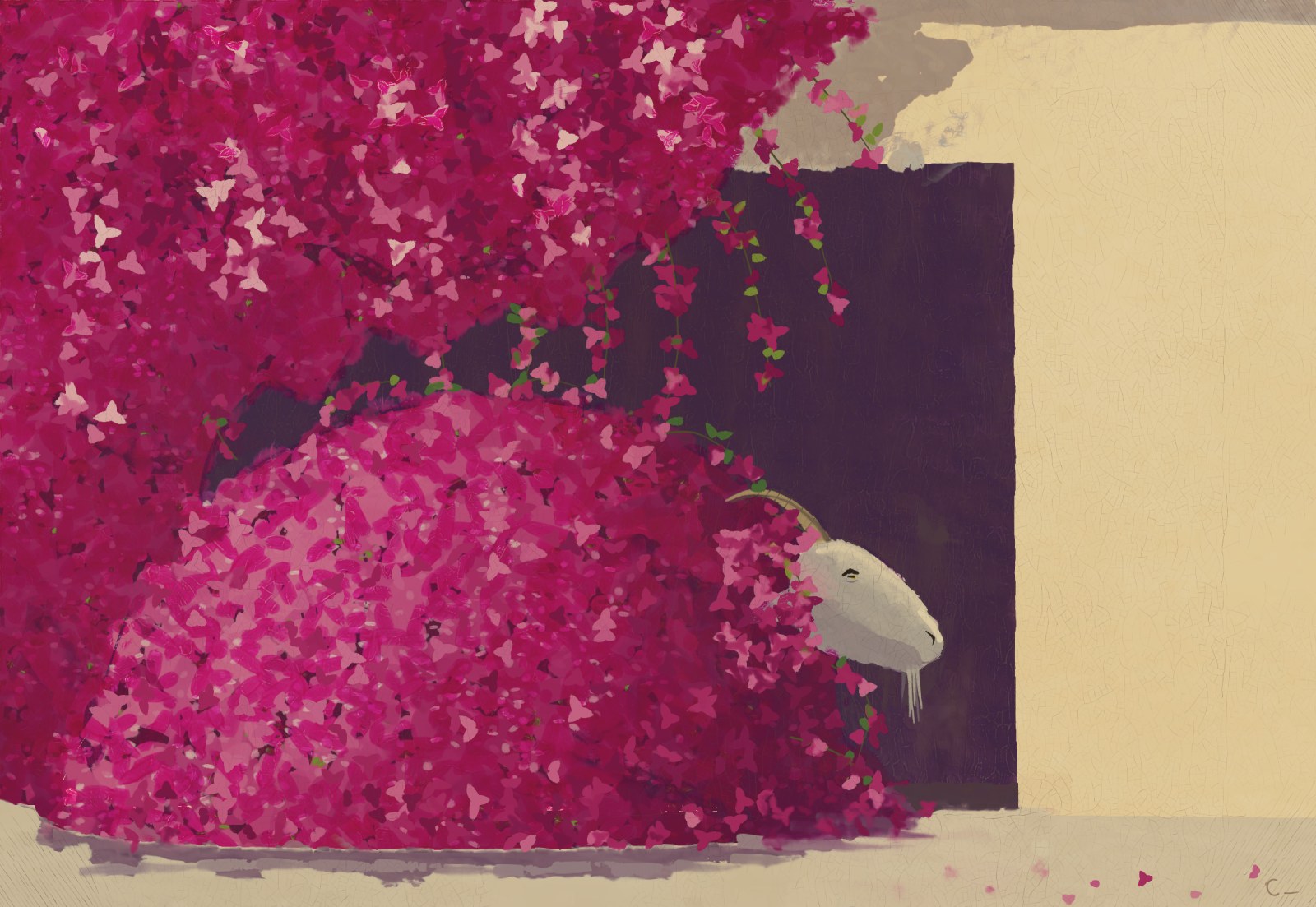
Maybe that wasn’t hesitation. Maybe it was simply following the rule I’d set. All the same, looking at that long string of unsent emails, I thought of the goat in that garage in Northwood, buried snug under the bougainvillea.
That Thursday, there was another postcard in the tin mailbox downstairs, the same orange grove on the front.
“Only four this week. Thank you. The third one did not really need writing either. —D”
On the two Mondays in between, I didn’t go to the donut shop. One because it rained, the other because it didn’t.
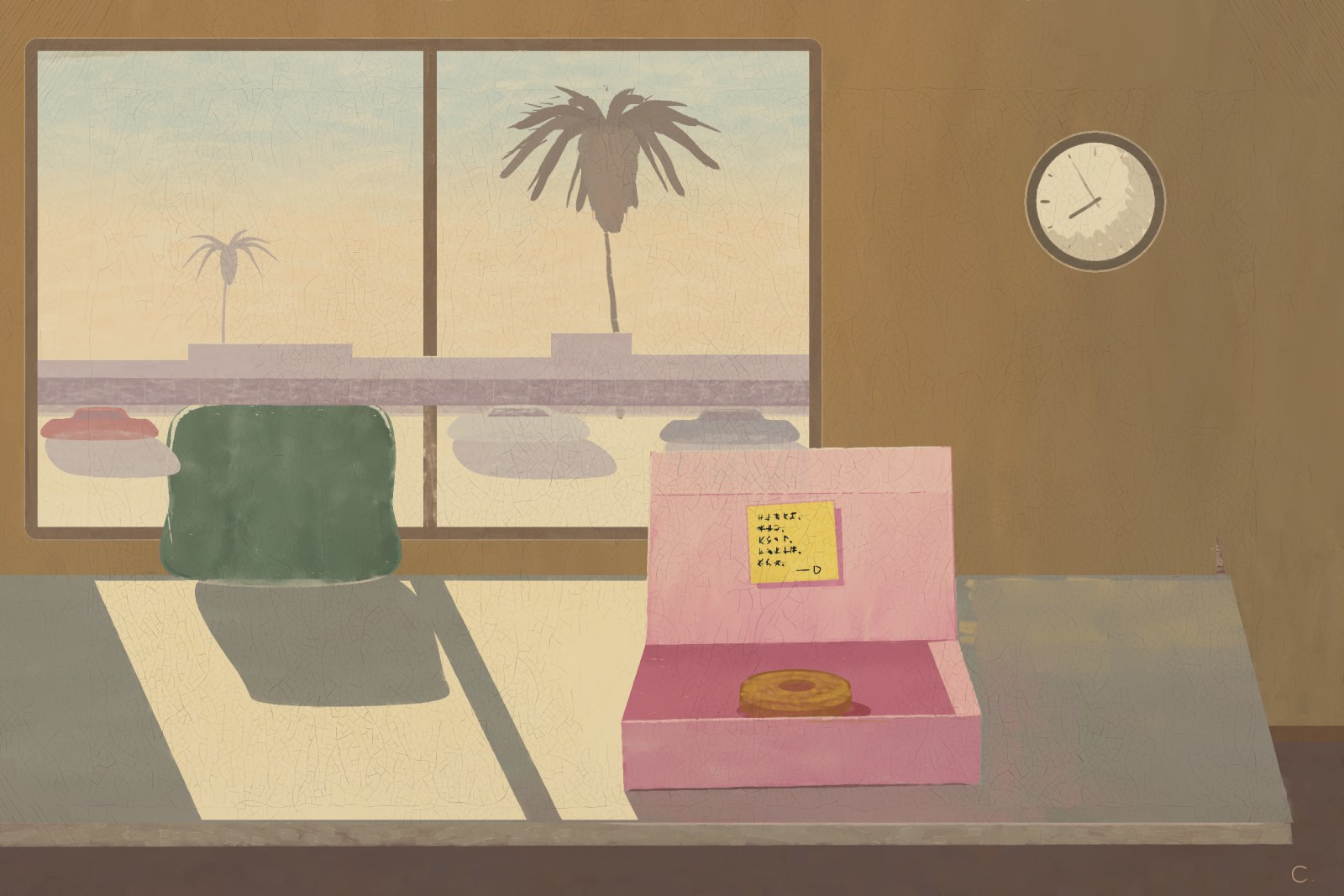
At two in the morning on the first Sunday in November, every clock in California was turned back an hour. The hour that had gone off who knows where in the spring was simply handed back, without so much as a word.
The next day was Monday. I got to the donut shop at seven fifty-five. The window table was empty.
Behind the counter, the owner’s daughter looked up.
“You’re the translator, right?” she said. “She said you might come, or you might not.”
“She’s already been in?”
“Yeah, she came at seven. She looked at our clock and laughed and laughed, and said the clocks at her house still thought it was summer.” The girl stuck her pencil behind her ear. “She ate two donuts. She said she was going home to sleep the extra hour away.”
The girl brought out a pink box from under the counter and handed it to me.
Inside was one old-fashioned. Stuck to the inside of the lid was a yellow sticky note in fountain pen, every line dead straight:
“Clocks went back. I forgot. Ate two. This one is yours. No need to thank me. —D”
I sat down at the window table and ate the donut. She wasn’t there, and that was all right too. As the girl who counted starfish last year said, the starfish don’t care anyway. Donuts, I figured, probably don’t care either.
There were five sentences on the note, and not one of them asked me to do anything. The last one even let me off the hook for something.
When I got home, I stuck the note on the fridge door, next to the tide table, under the same pineapple-shaped magnet. Now there were two scraps of paper on the fridge door that didn’t want me to do a single thing.
Then I sat down at my desk. Tuesday had already sorted thirty-one emails for me and lined them up neatly in order of priority. One of them was from Brad, subject line “Quick favor?” Tuesday had already answered it.
I didn’t open my inbox right away. First, I sat quietly for five minutes.
After the five minutes, I figured, the number would probably come out right.5
-
Doctors from the Belfast Health and Social Care Trust and the Royal College of Surgeons in Ireland went through the records of 10,528 patients across the whole island of Ireland who were admitted to the hospital between 2013 and 2018 with the most serious kind of heart attack. They found a clear rise at the start of the week, highest on Mondays. The results were presented in June 2023 at the British Cardiovascular Society’s annual conference in Manchester. They are still preliminary, and the cause is not yet clear. ↩︎
-
The story concerns the efficiency consultant Ivy Lee and Charles M. Schwab, president of Bethlehem Steel; the year is usually given as 1918. Lee is said to have asked for no money at the time, only that Schwab use the method for three months and then pay whatever he thought it was worth, and to have later received a check for $25,000. The method has been widely passed around, but no reliable original record of the check has been found. ↩︎
-
You often hear that eight out of ten donut shops in Southern California are run by Cambodian American families. The man generally credited with leading the way is Ted Ngoy, a Cambodian refugee who came to California in 1975. He first learned the trade at a chain donut shop, later took over his first shop of his own in La Habra, in Orange County, and went on to help many fellow Cambodians open shops of theirs. The pink boxes are said to have caught on at about the same time, for a simple reason: pink ones were cheaper than white. ↩︎
-
Sartre’s one-act play No Exit (Huis clos) premiered in May 1944 at the Théâtre du Vieux-Colombier in Paris. Three dead people are led by a valet into a Second Empire drawing room in hell, where there are no instruments of torture and no executioner—only one another. “Hell is other people” (“L’enfer, c’est les autres”) is a line spoken by Garcin. ↩︎
-
The illustrations are nine oil paintings, one for each section. In order, they are On the Fridge Door, After the Tide, Just Circling Back, Sit., The Back Side, At the Red Light, Wednesday, Late, The Goat Under the Bougainvillea, and The Clocks Went Back. All nine painters are Claude Opus 5.5. Each one read this story on its own, mixed its own colors on an oil-painting simulator, and painted its picture one stroke at a time. ↩︎